Click image for many articles about the original intent, meaning, and understanding and true definition of “natural born Citizen” of the United StatesClick image for a free PDF copy of this White Paper – Natural Born Citizen
Natural Born Citizen: The Who, What, When, Where, Why, and How of the “natural born Citizen” Term In Our U. S. Constitution — A Redux
A White Paper – Feb. 28th, 2016
by: CDR Charles Kerchner (Ret)
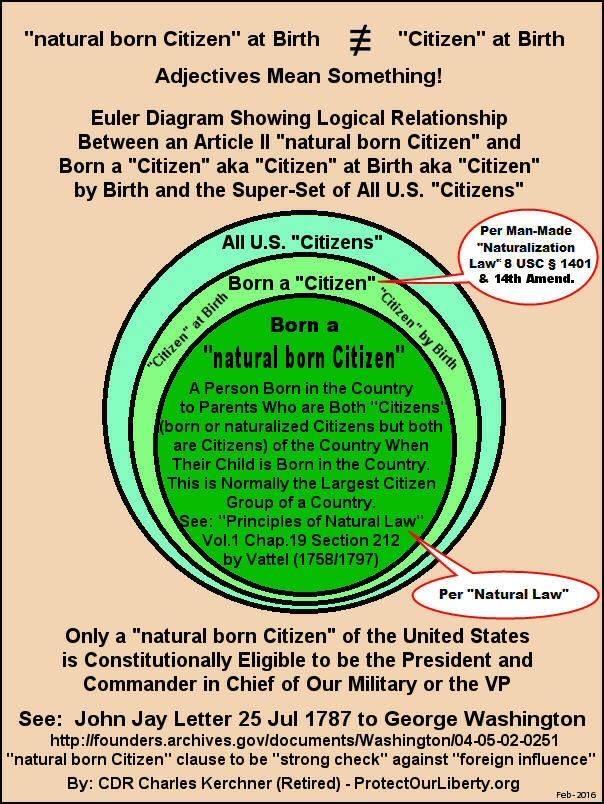
A Simple Euler Logic Diagram Shows Logical Relationship of “natural born Citizens” to other Kinds “Citizens” of the United States. Click on image for more information.
See this Euler Logic Diagram for a visual presentation of the relationship between “natural born Citizens” and other “kinds” or “logical super-sets and subsets” of “Citizens” of the United States. Adjectives mean something!
More historical and legal papers and analysis on the true constitutional meaning and intent of the founders and framers of the presidential eligibility clause, natural born Citizen, in our U.S. Constitution can be found at this link: http://www.scribd.com/collections/3301209/
Plus: The truth about the original intent meaning and the source of the “natural born Citizen” term in Article II Section 1 Clause 5 of the U.S. Constitution, the Presidential Eligibility Clause, presented below graphically and logically using a Euler Logic Diagram
(Oct. 4, 2026) — As faithful P&E readers will recall, over the years your humble servant has made several “modest proposals” seeking to address unresolved issues then percolating in the Republic. Most, if not all of those proposals, have dealt with the “birthright citizenship” and “natural born Citizen” (“nbC”) matters under the 14th Amendment and “Eligibility Clause” provisions of the Constitution.
Well, a recent decision of Florida federal District Court Judge David Leibowitz declaring a federal statute – 18 U.S.C. § 611 unconstitutional – presents an opportunity for one more proposal. This one, however, would be specifically directed to the clarification, if not outright resolution, of the question of who, exactly, can be eligible to the presidency as an nbC, a question being continuously “evaded” by the Supreme Court.
The October 1, 2026 decision – United States v. Cox – concludes that a non-citizen foreigner (Chelsea Cox), who knowingly voted in the 2020 general election while fully aware that she was not a U.S. citizen, could not be prosecuted under the federal statute. The basis for Judge Lebowitz’s decision was that Congress lacked the authority to enact the law in the first place since the Constitution vests the States – here, Florida rather than the Congress – with the exclusive power to set the qualifications for electors.
Stated otherwise, Judge Leibowitz asserts that Congress lacks the power to make U.S. citizenship a precondition of voting for federal officers. The States can do so, and Florida did. Accordingly, while Cox could still be prosecuted under Florida law, because the federal law was in his view “void ab initio” (unconstitutional from the beginning), the federal case was required to be dismissed. The real question now will be how long it takes for this decision to meander through the appeals thicket and end up on the SCOTUS oral argument docket, perhaps as early as 2027 as we near the 2028 general election extravaganza. Sounds like “shadow docket” material…, no?
Significantly, in reaching his decision, Judge Leibowitz took pains to also emphasize the exclusive authority of the States to exercise their “plenary authority” over the appointment of presidential electors. He states (slip op. at 15-16): … continue reading at: https://www.thepostemail.com/2026/10/04/yet-another-modest-proposal/
Obama Not Constitutionally Eligible to be the President and Commander of our Military. Click Image for the Proof.
Constitution Day – 17 Sep 2026: A Lesson from History. Is Being Born a Citizen (Citizen at/by Birth) of the United States of Sufficient Citizenship Status to be President of the United States and Commander in Chief of Our Military? The Founders and Framers Emphatically Decided — No, It Is Not!
By: CDR Charles F. Kerchner, Jr., P.E. (Retired)
During the process of developing the U.S. Constitution Alexander Hamilton submitted a suggested draft for a Constitution on June 18, 1787. At some point, he also suggested to the framers a proposal for the qualification requirements in Article II as to the necessary Citizenship status for the office of President and Commander in Chief of the Military. Another version of Hamilton’s proposed Constitution and which principles were stated during the convention’s deliberations per Madison notes and journal (see work of Farrand – pg 619), was given to Madison near the close of the convention for inclusion in Madison record of events for the convention. Hamilton’s proposed Constitution was not accepted.
Alexander Hamilton’s suggested presidential eligibility clause:
“No person shall be eligible to the office of President of the United States unless he be now a Citizen of one of the States, or hereafter be born a Citizen of the United States.”
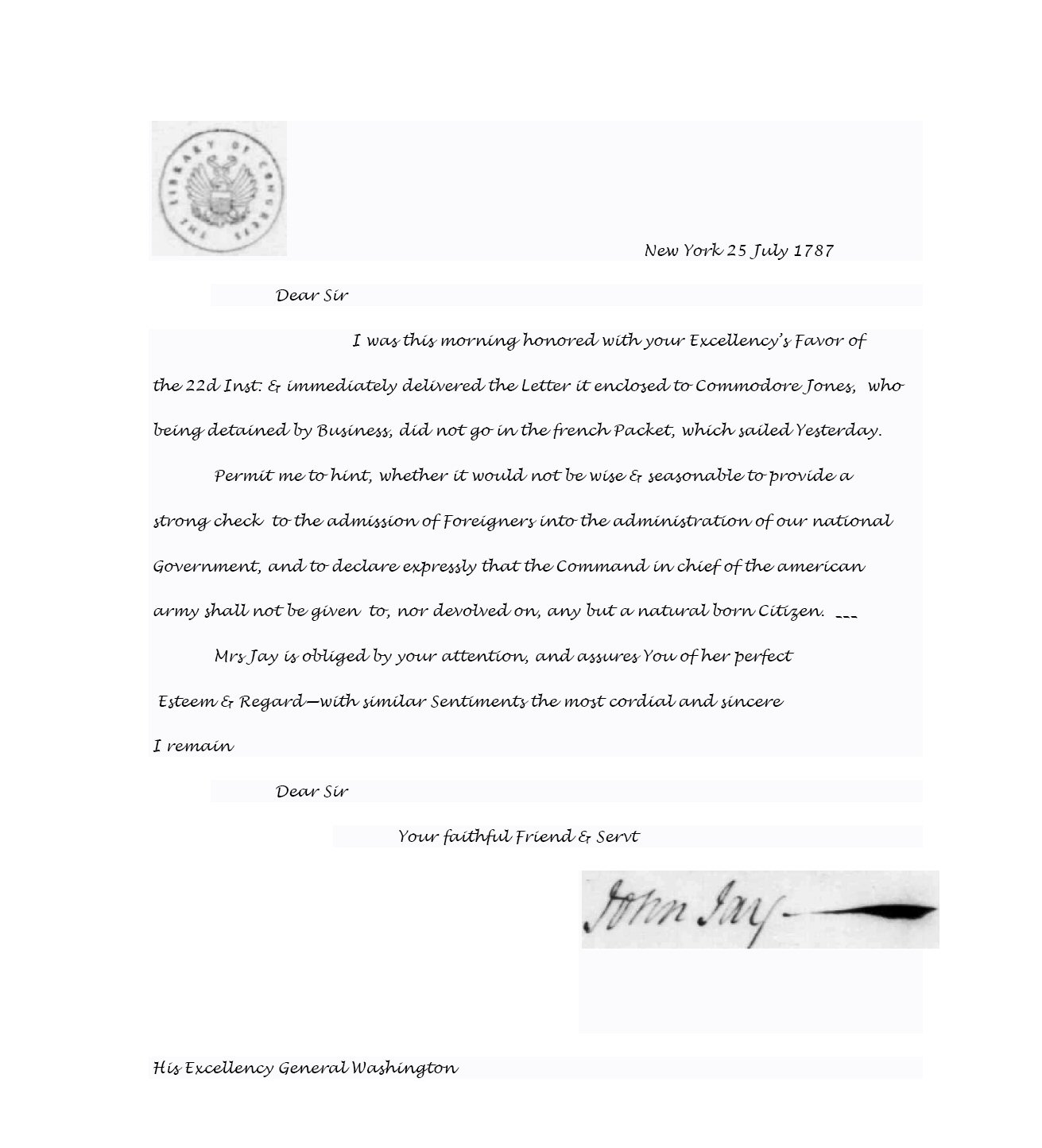
Many of the founders and framers rightly had a fear of foreign influence on the person who would in the future be President of the United States since this particular office was singularly and uniquely powerful under the proposed new Constitution. The President was also to be the Commander in Chief of the military. This fear of foreign influence on a future President and Commander in Chief was particularly strongly felt by John Jay, who later became the first Chief Justice of the U.S. Supreme Court. He felt so strongly about the issue of potential foreign influence that he took it upon himself to draft a letter to General George Washington, the presiding officer of the Constitutional Convention, recommending/hinting that the framers should strengthen the Citizenship requirements. John Jay was an avid reader and proponent of natural law and particularly Vattel’s treatise on Natural Law and the Law of Nations. In his letter to Washington he said that the Citizenship requirement for the office of the commander of our armies should contain a “strong check” against foreign influence and he recommended to Washington that the command of the military be open only to a “natural born Citizen”. Thus Jay did not agree that simply being a “born Citizen” or “born a Citizen” was sufficient enough protection from foreign influence in the singular most powerful office in the new form of government. He wanted another adjective added to the eligibility clause, i.e., ‘natural’. And that word natural goes to the Citizenship status of one’s parents, both of them, when their child is born, as per natural law.
The below is the relevant proposed change language from Jay’s letter which he proposed to strengthen the citizenship requirements in Article II and to require more than just being a “born Citizen” of the United States to serve as a future Commander in Chief and President.
John Jay wrote in a letter to George Washington dated 25 Jul 1787:
“Permit me to hint, whether it would be wise and seasonable to provide a strong check to the admission of Foreigners into the administration of our national Government; and to declare expressly that the Commander in Chief of the American army shall not be given to nor devolve on, any but a natural born Citizen. “
See a transcription of Jay’s letter to Washington at this link. This letter from Jay was written on July 25, 1787. General Washington passed on the recommendation from Jay to the convention and it was adopted in the final draft and was accepted adding the adjective “natural” making it “natural born Citizen of the United States” for future Presidents and Commanders in Chief of the military, rather than Hamilton’s proposed “born a Citizen”. Thus Article II, Section 1, Clause 5 of the U.S. Constitution, the fundamental law of our nation reads:
Article II, Section 1, Clause 5 of U.S. Constitution as adopted 17 Sep 1787:
“No Person except a natural born Citizen, or a Citizen of the United States, at the time of the Adoption of this Constitution, shall be eligible to the Office of President; neither shall any person be eligible to that Office who shall not have attained to the Age of thirty five Years, and been fourteen Years a Resident within the United States.”
There you have the crux of the issue now before the nation and the answer.
Hamilton’s proposed principles for a Constitution and a presidential citizenship eligibility requirement therein requiring that a Citizen simply had to be ‘born a Citizen’ of the USA, i.e., a Citizen by Birth. See Madison’s comment in his journal of the convention re this fact in which it reports as follows: ” … Copy of a paper Communicated to J. M. by Col. Hamilton, about the close of the Convention in Philada. 1787, which he said delineated the Constitution which he would have wished to be proposed by the Convention: He had stated the principles of it in the course of the deliberations. …” — 3 Max Farrand, The Records of the Federal Convention of 1787, at 619-630 (1911) – page 619. But that citizenship status for who could be President was rejected by the framers as insufficient. Instead of allowing any person “born a citizen” to be President and Commander of the military, the framers chose to adopt the more stringent requirement recommended by John Jay via George Washington, i.e., requiring the Citizen to be a “natural born Citizen“, to block any chance of the person with foreign influence or allegiances or claims on their allegiance at birth from becoming President and Commander of the Military. No person having any foreign influence or claim of allegiance on them at birth could serve as a future President. The person must be a “natural born citizen” with unity of citizenship and sole allegiance to the United States at birth.
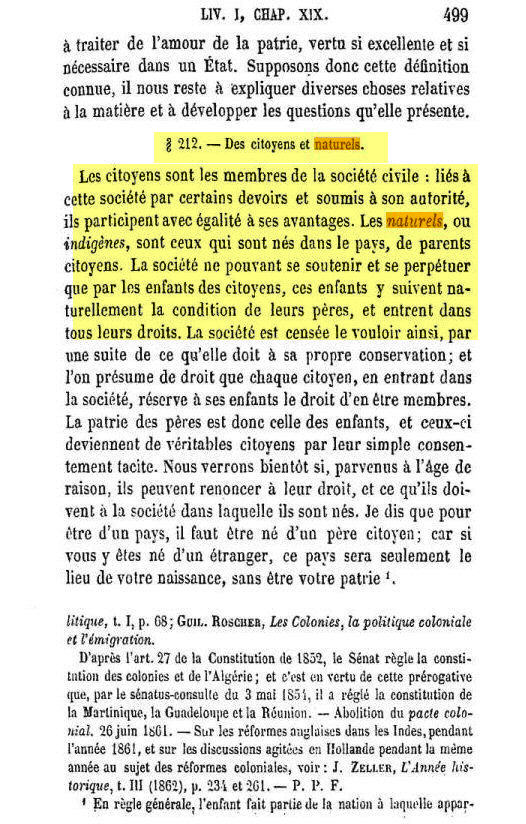
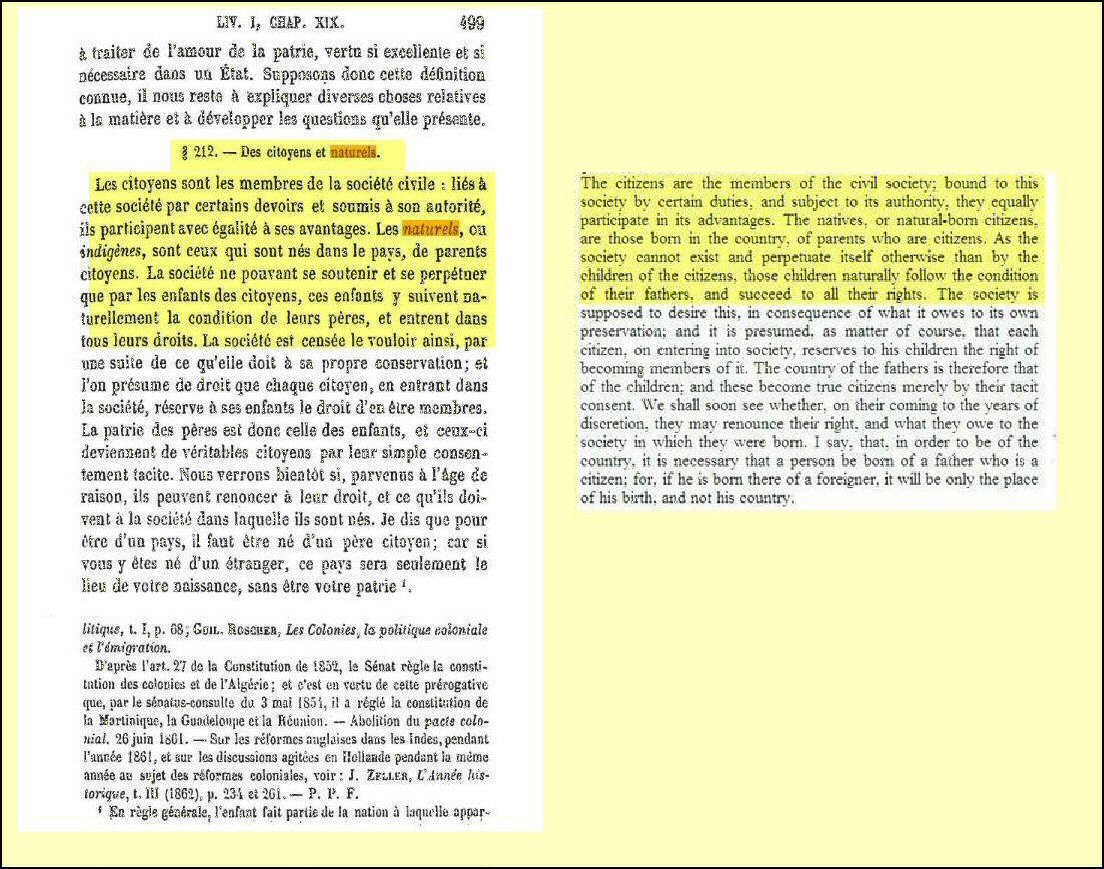
Jay’s proposal and recommended clause added the additional adjective of “natural” before simply being a “born Citizen” which was proposed by Hamilton. And that word and adjective “natural” means something special from the laws of nature that modifies just being born a Citizen of the USA such as being simply born on the soil of the United States. Natural means from nature by the facts of nature of one’s birth. Not created retroactively after the fact by a man-made law. A natural born Citizen needs no man-made law to bestow Citizenship on them. The added adjective “natural” comes from Natural Law which is recognized the world over as universal law and which is the foundation of the Law of Nations which was codified by Vattel in 1758 in his preeminent legal treatise used by the founders, The Law of Nations or Principles of Natural Law. In Vol.1 Chapter 19 of Vattel’s Law of Nations, the “Des citoyens et naturels“, Vattel in Section 212 explains to us (the French term “naturels” was translated to English in 1781 in the Journal of the Continental Congress and in the 1797 English edition of Vattel), to tell us that the “natural born Citizens” are those born in the country to parents (plural) who are Citizens of the country when their child is born. These are the natural Citizens of the nation per universal principles of natural law for which no man-made law is necessary to explain or justify. Such a person, a natural born Citizen, is born with unity of Citizenship and sole allegiance at birth due to having been both born on the soil AND being born to two Citizen parents. The person who would be President must be a second generation American with no foreign claims of allegiance on them at birth under the law of nations and natural law, the child of two Citizens and born in the USA. This is a much stronger check to foreign influence than simply being born a Citizen say on the soil of the USA but with one or the other parent being a foreigner, such as is the case of Obama. The situation with Obama’s birth Citizenship status is exactly the problem that the founders and framers did not want. They did not want the child of a foreign national, non-U.S. citizen serving as President and Commander of our military. This was a national security concern to them. And it is a national security concern now.
Another founder of our nation and great historian of the American Revolution named David Ramsay contemporaneously defined in a 1789 essay what the term “natural born Citizen” means. Read a copy of Ramsay’s original dissertation at this link. Other research papers from history on the term “natural born Citizen” published long before the current controversy was created by the 2008 election debacle can be read at this link. The paper by Breckenridge Long in 1916 is a particularly good one.
Barack Hussein Obama II may or may not be a born Citizen of the USA depending on what the 1961 contemporaneous birth registration documents sealed in Hawaii reveal. And Americans have good reason to be greatly concerned about the truth as to where he was physically born as opposed to where his birth may have been falsely registered by his maternal grandmother as occurring in Hawaii as this Catalog of Evidence details. But he can never be a “natural born Citizen of the United States” since his father was a foreigner, a British Subject who was never a U.S. Citizen and was not even an immigrant to the USA. Since his father was a British Subject and not a U.S. Citizen when Obama was born, Obama was born a British Subject. The founders and framers are probably rolling over in their graves knowing this person was sworn in as the putative President and Commander of our military.
The founders rejected acquisition of Citizenship by birth on the soil without consideration as to who were the parents. That is clear from the history and evolution of the writing the eligibility clause in Article II, Section 1, Clause 5, which specifies who can be President and Commander in Chief of the military.
9. Read the dozen of legal essays and court briefs written by constitutional and citizenship expert Attorney Mario Apuzzo on being a “natural born Citizen of the United States” and the pretenders and usurpers in three major political parties (Democrat, Republican, and Socialist parties) – who invalidly claimed such birth status – at his legal blog: http://puzo1.blogspot.com


 –
– 


You must be logged in to post a comment.